
Nikro Air Quality & Sanitizing in Seattle: What to Know First
Bellows Air Duct & Vent Co. of Seattle provides independent Nikro air quality and sanitizing services to homeowners across the city, from Ballard to Beacon Hill. Most Nikro mold treatments, bacteria sanitizing, and odor removal jobs are completed in a single visit, with upfront pricing given before we start - the number you hear on the phone is the number on the invoice. We are not affiliated with or authorized by Nikro; we are an independent Nikro service provider with no ties to the manufacturer.
This page is for Seattle homeowners who already have a Nikro air scrubber, UV system, or portable sanitizing unit and need it serviced, cleaned, or replaced by someone who knows the equipment. If your Nikro unit is running but not pulling odors, or if you’ve noticed musty airflow returning after a rainy Seattle winter, call us at (833) 700-5198. We’ll answer live, day or night.
How Nikro Products Fail - and How We Fix Them
- UVPCO series lamps burn out prematurely in Seattle’s damp climate. The Pacific Northwest’s high humidity causes corrosion at the lamp socket contacts, especially in basements and crawl spaces where these units are often mounted. We see this in Greenwood and Phinney Ridge homes with older foundations. Our fix: we clean the socket housing with a contact-safe solvent, install a corrosion-resistant ceramic socket if needed, and verify UV-C output with a meter before we leave. OEM lamps last longer, but we also stock quality aftermarket UV bulbs that meet the same 253.7 nanometer specification at a lower cost.
- APS-2000 and APS-3000 air scrubbers lose airflow after two to three pollen seasons. The electrostatic cell grids in these whole-house units clog with fine Pacific Northwest fir and cedar pollen, which is stickier than Midwest grass pollen. Homeowners near Discovery Park and the Arboretum notice this first. We remove the cell assembly, wash it in a degreasing solution, inspect for bent ionizing wires, and test static pressure drop across the unit. Bent wires get replaced, not straightened - straightening weakens the tungsten and causes arcing.
- Portable Nikro HEPA units (H500, H1000 series) develop motor bearing noise after sustained use. These units run hard during Seattle’s wildfire smoke events, which have become more frequent since 2012. The motors are sleeve-bearing designs that don’t tolerate continuous duty well. We source OEM motor assemblies from Nikro’s US distributor, but we also keep a rebuilt motor program for discontinued H500 units - a parts nuance Nikro’s own site won’t tell you exists.
- Nikro fogging machines (FG-100, FG-200) clog at the nozzle orifice with hard water mineral deposits. Seattle’s water supply is moderately hard, ranging from 1.2 to 1.8 grains per gallon depending on whether you’re on Seattle Public Utilities or a well in the outer neighborhoods. The ceramic orifice in these foggers is precisely machined to 0.3mm, and scale buildup throws off droplet size. We descale with food-grade citric acid, never hydrochloric-based solutions that etch the ceramic, and we install an inline sediment filter if the homeowner plans regular fogging.
- APS series carbon after-filters saturate faster than rated in homes with gas cooking. The 4-pound carbon bed in the APS-2000 is rated for 12 months, but Seattle’s tight building envelopes and frequent gas range use overload it in 7 to 9 months. We see this in Capitol Hill condos and Wallingford bungalows with original kitchens. We stock the OEM carbon canister, but we also offer an upgraded 8-pound canister from a third-party supplier that fits the same housing - it costs more upfront, but the cost-per-month is lower and the odor control is noticeably better during cooking season.
Our Nikro Air Quality & Sanitizing Process
- 1
Call and schedule. A live person answers, 24 hours a day. We ask what Nikro equipment you have, what symptoms you’re seeing, and when you first noticed the change. We give you a price range before we schedule.
- 2
Camera inspection and diagnosis. Our technician arrives in a marked van, uniformed and background-checked. We inspect your Nikro unit and the connected ductwork with a borescope camera - you see what we see on the screen. For UV units, we measure actual UV-C output. For air scrubbers, we test static pressure and airflow at the return grille.
- 3
Parts decision, explained. If something needs replacing, we show you OEM and quality aftermarket options, with the price difference and warranty terms for each. No pressure either way. You choose before we open a tool case.
- 4
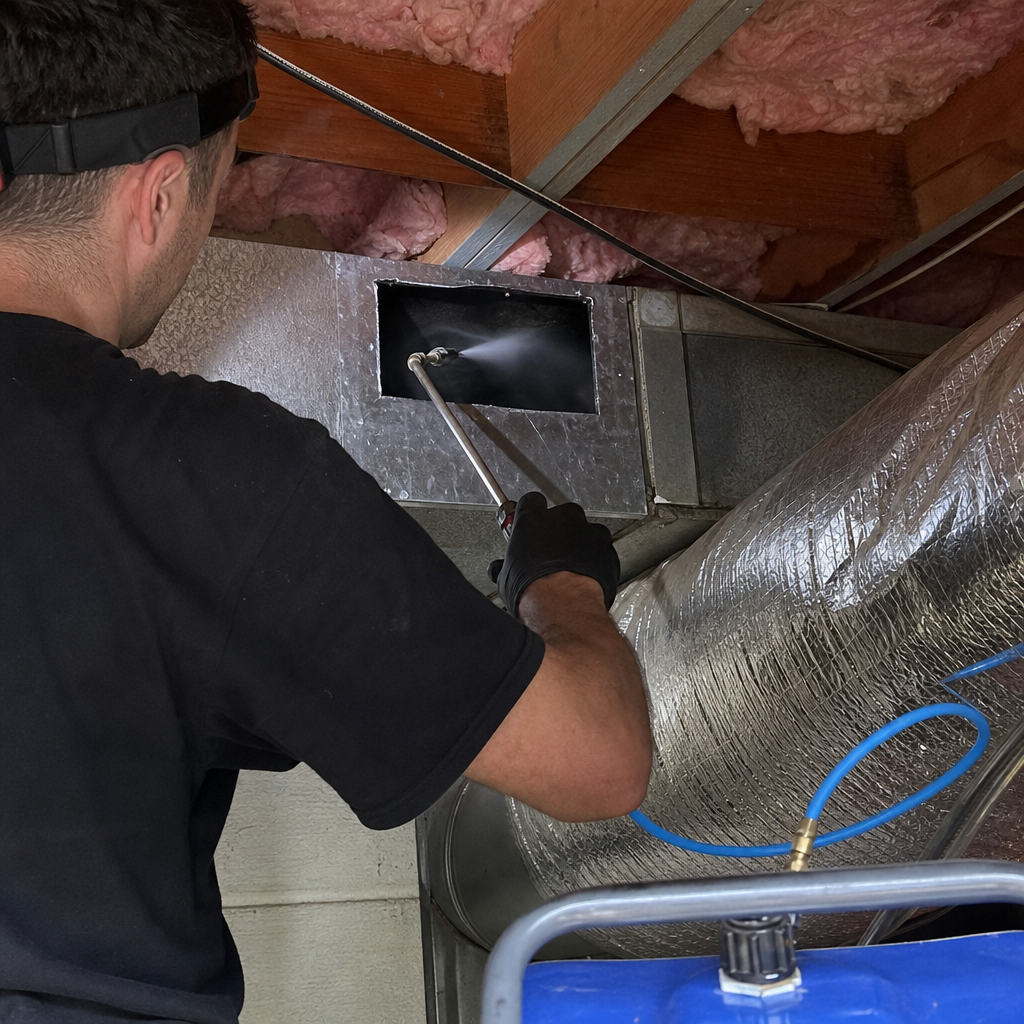
The service. We work clean - drop cloths, shoe covers, HEPA vacuum if we’re cutting into ductwork. For sanitizing jobs, we fog or treat according to the manufacturer’s specification for your specific Nikro model, not a generic protocol.
- 5
Post-service verification. We run the unit through a full cycle, measure output again, and show you the before-and-after camera footage. The invoice matches the quote.
- 6
The 90-Day Done Right Promise. If something isn’t right, we come back and make it right. No paperwork to fill out, no argument. We stand behind the work because we have been doing it long enough to know what standing behind it actually means.
What Nikro Air Quality & Sanitizing Costs in Seattle
| Service | Typical Range | What Moves the Price |
|---|---|---|
| UV lamp replacement (UVPCO series) | $180 - $340 | OEM vs. aftermarket lamp; socket condition; access difficulty |
| Electrostatic cell cleaning (APS-2000/3000) | $220 - $395 | Cell condition; wire replacement count; duct access |
| Portable HEPA motor replacement (H500/H1000) | $280 - $450 | OEM vs. rebuilt motor; filter replacement at same time |
| Fogging machine descale and service (FG-100/200) | $150 - $275 | Scale severity; orifice replacement needed; inline filter add-on |
| Carbon after-filter upgrade (APS series) | $195 - $320 | Standard 4-lb vs. upgraded 8-lb canister |
| Full system sanitizing (fogging + UV verification) | $395 - $650 | Square footage; contamination level; number of zones treated |
These are Seattle-market ranges based on what we’ve billed in the last 18 months. Your exact quote depends on what we find when we look. Call (833) 700-5198 for a free estimate - we’ll give you a firm number after a brief phone consultation, and that number won’t change when we arrive.
Why Seattle Homeowners Call Bellows Air Duct & Vent Co. of Seattle for Nikro Work
Colin Merritt grew up in Ballard when the neighborhood still smelled like the fishing industry more than coffee shops, and he’s spent the better part of three decades cleaning and inspecting duct systems across Seattle. He knows which Nikro models were installed in the 1990s West Seattle rebuilds, which ones are running in the pre-war homes of the Central District, and how the city’s shifting humidity patterns affect each.
Our technicians are trained on Nikro equipment specifically, but they also carry Lennox, Trane, and Carrier parts and knowledge - because most Seattle homes have mixed systems, and the air quality component has to work with the whole HVAC setup, not exist in isolation. Every job gets camera verification, upfront pricing, and the 90-Day Done Right Promise in writing. Calls are answered by a live person, 24 hours a day, not a voicemail tree. Most jobs finish in one visit. We’ll be there when we say.
FAQs
No. As an independent Nikro service provider, we use OEM-specification parts and follow manufacturer service protocols, which preserves any remaining warranty coverage. The warranty was designed to exclude damage from improper service, not to lock you into a single service channel. If your unit is still under warranty, we’ll note that in our records and service accordingly. Call (833) 700-5198 and we’ll check your serial number against Nikro’s warranty database.
Most residential Nikro air quality and sanitizing jobs are completed in two to four hours, including setup, service, verification, and cleanup. Whole-house fogging with multiple zones takes longer; a simple UV lamp swap in an accessible attic takes less. We schedule with a time window, not an all-day wait. Call (833) 700-5198 to book - estimates are free.
Repair if the unit is under ten years old and the repair costs less than half of replacement. Replace if the unit is over fifteen years old, uses discontinued parts, or has required two or more repairs in the past three years. For Nikro units in the 10-to-15-year range, we give you both numbers and our honest assessment - no scare tactics, no pressure. The $89 Seasonal Tune-Up is a good way to get a full condition report before deciding. Call (833) 700-5198 to schedule.
We stock common parts for Nikro units going back to the late 1990s, including rebuilt motors for discontinued H500 series portable units - a parts source Nikro’s own website won’t direct you to. For obsolete components, we cross-reference with Lennox, Trane, and Carrier equivalents where safe and appropriate. If we don’t have it, we’ll tell you before we schedule, not when we’re standing in your living room. Call (833) 700-5198 with your model number.
Yes. A burning smell from any air quality equipment is a safety concern, and we treat it as urgent. We answer calls live 24 hours a day, and we keep same-day slots open for situations like this. Do not run the unit until we’ve looked at it - electrical issues in damp Seattle basements can escalate quickly. Call (833) 700-5198 now.
Written by Colin Merritt, Owner, Bellows Air Duct & Vent Co. of Seattle at Bellows Air Duct & Vent Co. of Seattle, serving Seattle and nearby areas.